Cooling a room shouldn't mean watching your energy bill climb every month. Mr. Electric talks with homeowners all the time about practical ways to reduce energy use. A high-efficiency ceiling fan is one of the simplest upgrades that can support your heating and cooling system year-round. If you want to understand how the right fan can lower costs and improve airflow, keep reading.
The Difference Between Standard and High-Efficiency Models
A standard fan might push air around, but a high-efficiency model is engineered to deliver more cubic feet per minute per watt of energy consumed. The ratio is a serious measure of performance.
High-efficiency fans typically use DC motors instead of the AC motors found in older or budget models. DC motors consume up to 70% less electricity while producing more torque and running quieter. The blade pitch and aerodynamic design also play a role. Manufacturers engineer these blades to cut through air with less resistance, which means more airflow at lower speeds.
The Energy Star certification is a reliable benchmark. Energy Star-certified ceiling fans move air 20% more efficiently than standard models on average. The difference adds up across a full cooling season, especially in a home running multiple fans.
How Ceiling Fans Support Your HVAC System
A ceiling fan doesn't lower the temperature in a room. What it does is create a wind chill effect that makes the air feel cooler on your skin, which lets you raise your thermostat. The Department of Energy estimates that raising the thermostat by four degrees while running a ceiling fan can cut cooling costs by up to 8% per degree.
Your air conditioner runs fewer cycles, which also means less wear on the compressor, lower electricity consumption, and a longer lifespan for your HVAC equipment. A ceiling fan pulling a few watts replaces the demand that would otherwise fall on a system drawing thousands of watts.
In winter, reversing the fan to spin clockwise at low speed pushes warm air that has risen to the top of the ceiling back down along the walls. It reduces how hard your heating system works to maintain temperature, which cuts energy use in both directions across the year.
Using Seasonal Fan Direction to Maximize Savings
Most homeowners know ceiling fans help in summer, but the winter setting goes unused in a lot of homes. The direction switch, which is usually located on the motor housing, controls which way the blades spin. Counter-clockwise rotation in summer pulls warm air up and pushes cool air down. Clockwise rotation in winter does the opposite.
Running a fan clockwise at low speed during heating season redistributes stratified warm air without creating a draft. Rooms with high ceilings benefit most from this. Heated air can sit eight to ten feet above the floor while your thermostat reads the temperature at head height and keeps cycling the furnace.
Switching direction twice a year takes about 30 seconds. The energy savings from doing it consistently can reduce heating costs by up to 15% in rooms where warm air stratification is a problem. It's a simple mechanical change that costs nothing to use.
Why Proper Installation Impacts Performance
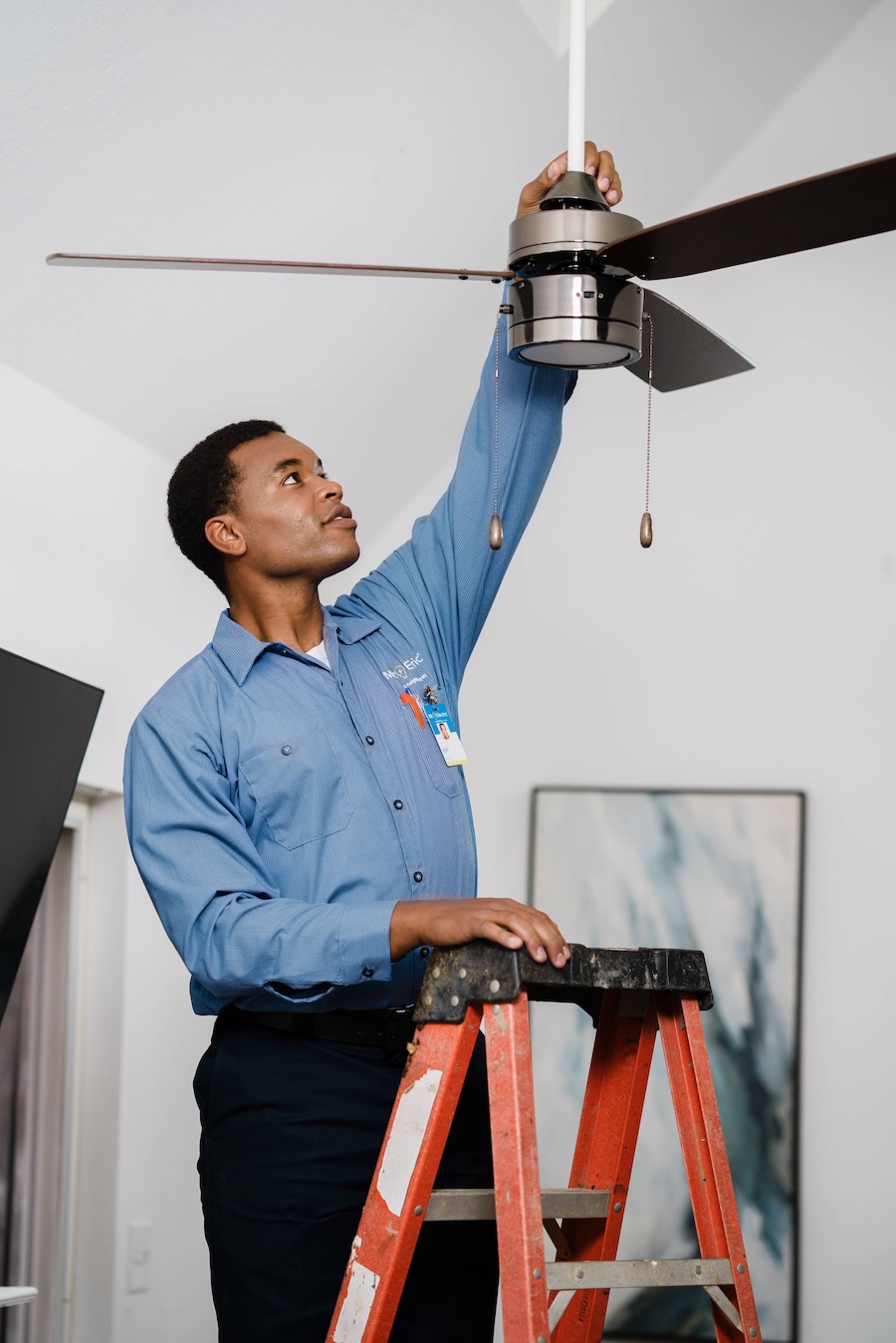
A high-efficiency fan installed incorrectly will not perform to spec. Mounting height is one of the biggest factors. Ceiling fans work best when the blades sit seven to nine feet above the floor. If it's too high, the airflow dissipates before it reaches the people in the room. When it's too low, the fan creates turbulence rather than circulation.
Electrical connections also matter. A fan wired to an incompatible dimmer switch instead of a proper fan speed control will hum, run erratically, or fail early. This is one situation where calling electricians makes a difference in long-term performance. Proper wiring, secure mounting to a rated electrical box, and correct blade alignment all affect how efficiently the motor runs.
If your current fan wobbles, hums, or doesn't respond correctly to speed settings, those can be signs of an installation problem rather than a defective product. An electrical repair can resolve most of these issues without replacing the fan completely. But if the motor is worn or the fan is more than ten years old, ceiling fan replacement is likely the more cost-effective path.
When an Upgrade Makes Financial Sense
Older fans with AC motors, plastic blades, and no Energy Star rating cost more to run every year than a newer high-efficiency model costs to buy. The break-even point on a quality ceiling fan replacement is typically 12 to 24 months when you factor in reduced electricity consumption and lower HVAC demand. A few situations where upgrading makes the most financial sense:
- Your current fan runs on the highest speed setting just to move adequate air.
- Your electricity bill has increased, but your usage habits haven't changed
- The fan is more than ten to fifteen years old and lacks a DC motor or an Energy Star rating
- You're adding a fan to a room that doesn't have one, and want to offset HVAC costs from the start
Scheduling an electrical service call to check your current fans and wiring is a great first step. An electrician can find out whether your existing ceiling boxes are rated for fan weight and if your wiring supports modern fan controls.
Get the Right Fan Installed the Right Way
A high efficiency ceiling fan is one of the few home upgrades where the payback is fast, the installation is simple for a qualified electrician, and the benefits run year-round. Mr. Electric provides professional electrical service for homeowners who want the job done right the first time. Our electricians handle everything from ceiling fan replacement to full electrical repair, and we'll make sure your fans are wired, mounted, and configured to perform at their best. Contact Mr. Electric to schedule your installation today.